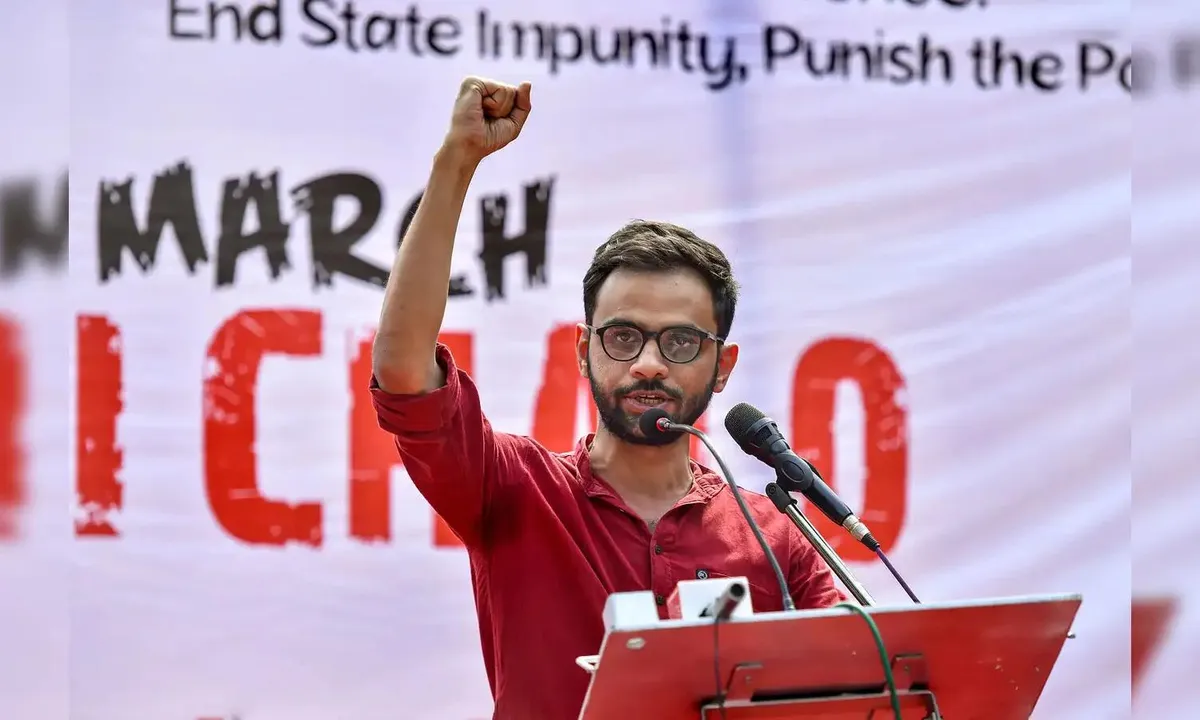
Umar Khalid is an Indian activist, researcher and author who became widely known through his involvement in student politics at Jawaharlal Nehru University (JNU). His public profile grew through his participation in student movements and debates surrounding civil liberties, citizenship and social justice.
Alongside his activism, Khalid has an academic background in history. He studied at the University of Delhi and later pursued higher education and research at JNU. His academic work has focused particularly on the history and political experiences of Adivasi communities in the Singhbhum region of Jharkhand.
Over the years, Umar Khalid has become a prominent and controversial figure in Indian public life. His name has been associated with the 2016 JNU controversy, protests surrounding the Citizenship Amendment Act (CAA), and the ongoing legal proceedings connected with the 2020 Northeast Delhi riots.
His academic work received renewed attention in 2026 following the publication of his doctoral research as Fractured Communities: Adivasi Histories and the Politics of Power. The book examines the history and political agency of the Ho community in Singhbhum.
| |
|---|
| |
| |
| |
| |
| |
| Activist, Researcher & Author |
| |
| Kirori Mal College, University of Delhi |
| Jawaharlal Nehru University |
| Student activism, public activism and academic research |
| Fractured Communities: Adivasi Histories and the Politics of Power |
| |
| Accused in an ongoing case |
Umar Khalid is an activist, researcher and author whose public career developed during his years as a student at JNU.
He became associated with the Democratic Students' Union and participated in campus discussions and political activities. His involvement in student politics eventually brought him into wider national debates about freedom of expression, citizenship and civil liberties.
His public profile grew significantly following the 2016 JNU controversy. Since then, his activism, legal case and academic work have continued to attract national attention.
While his activism has made him a polarising figure, his academic research represents another important part of his career. His doctoral work on Adivasi history was eventually published as a book in 2026.
Umar Khalid was born on 11 August 1987 in New Delhi, India.
His father, Syed Qasim Rasool Ilyas, has been involved in political and social activities and is associated with the Welfare Party of India.
Khalid grew up in Delhi and later developed an interest in history, politics and social issues. His university years became particularly important in shaping his academic interests and involvement in student activism.
Education has remained an important part of Umar Khalid's career.
He studied History at Kirori Mal College, University of Delhi, before joining Jawaharlal Nehru University for higher studies.
At JNU, he pursued postgraduate studies and research in history. His academic interests gradually developed around the history and political experiences of Adivasi communities.
His doctoral research focused on the Ho community of Singhbhum in Jharkhand and examined questions surrounding political authority, community structures and changing systems of power.
The research later became the foundation for his book Fractured Communities.
JNU occupies an important place in Umar Khalid's public journey.
During his years at the university, he became involved in student politics and was associated with the Democratic Students' Union. His participation in campus debates eventually brought him into the national spotlight.
The university became particularly significant in 2016 when Khalid was involved in a controversy surrounding a student event. The incident generated a nationwide debate about student politics, freedom of expression and sedition laws.
Even after his student years, JNU continued to be associated with his public profile. In August 2026, a student-organised discussion about his book was cancelled by the university administration, which cited incomplete disclosure of programme details. Students later held the discussion on campus despite the cancellation of the original venue.
Umar Khalid's involvement in student activism developed during his time at JNU.
He participated in campus discussions, demonstrations and debates concerning political and social issues. His activities brought together his academic interests and his growing involvement in public affairs.
Over time, his participation in student politics extended beyond the university environment. Public speeches and political discussions helped establish him as a recognisable student activist.
This period eventually led to the 2016 controversy that dramatically increased his national visibility.
The 2016 JNU controversy was a major turning point in Umar Khalid's public life.
In February 2016, a controversial event was held at JNU. Khalid and fellow student Anirban Bhattacharya were subsequently arrested in connection with allegations arising from the event and faced sedition charges. They were later released on bail.
The controversy sparked a nationwide debate about freedom of expression, student politics and the use of sedition laws.
For Khalid, the incident marked a transition from being primarily known within university circles to becoming a nationally recognised and highly debated public figure.
Following the 2016 controversy, Umar Khalid continued to participate in public activism.
His activities have included discussions and campaigns related to civil liberties, social justice, citizenship and political rights.
He was also associated with United Against Hate, a campaign launched in 2017 in response to incidents of mob violence and social tensions.
His activism has attracted both support and criticism. Supporters have presented him as a voice for civil liberties and political dissent, while critics have strongly disagreed with his political views and positions.
As a result, Khalid's public image has remained politically polarised.
Umar Khalid was also involved in public discussions and mobilisation surrounding the Citizenship Amendment Act (CAA).
The legislation became the subject of major protests and political debate across India. Student groups, activists and civil-society organisations participated in demonstrations opposing the legislation.
Khalid became associated with the wider protest movement and spoke publicly about citizenship, constitutional rights and social justice.
His involvement in the CAA protests further expanded his public profile beyond the university environment.
The 2020 Northeast Delhi riots case is one of the most significant aspects of Umar Khalid's recent public profile.
Khalid was arrested in September 2020 and faces charges under the Unlawful Activities (Prevention) Act (UAPA) and other provisions in the larger-conspiracy case related to the riots.
The prosecution has alleged that Khalid was involved in a larger conspiracy connected with the violence. Khalid has denied the allegations.
In January 2026, the Supreme Court denied bail to Khalid and Sharjeel Imam, while granting conditional bail to five other accused. The court held that Khalid and Imam stood on a different footing in the alleged conspiracy.
The legal proceedings continued during 2026. In April, the Supreme Court dismissed Khalid's review petition against the January bail decision.
In May, another Supreme Court bench expressed reservations about the approach taken in the earlier bail decision and referred broader questions concerning bail under special laws such as the UAPA to a larger bench.
A Delhi court also rejected fresh bail applications in July, citing the Supreme Court's January order.
It is important to note that Khalid is an accused in an ongoing case and has not been convicted in the 2020 Delhi riots case.
Although Umar Khalid is primarily known publicly for activism, academic research is another important part of his career.
His doctoral research focused on the history of Adivasi communities in the Singhbhum region of Jharkhand.
His work examines the relationship between Adivasi communities, political authority and changing systems of power. It also explores how local political structures interacted with colonial and postcolonial governments.
The research eventually became the basis for his published book, bringing greater attention to his work as a historian and researcher.
Umar Khalid's doctoral research was published as Fractured Communities: Adivasi Histories and the Politics of Power in 2026.
The book focuses on Adivasi history and political agency, particularly through the experiences of the Ho community in Singhbhum, Jharkhand.
A review published by The Indian Express described the book as an extensive study of Adivasi politics and agency and highlighted its examination of the Ho community's history.
The publication has brought renewed attention to Khalid's academic identity alongside his better-known role as an activist.
In July 2026, Khalid also wrote about his doctoral thesis and its publication, explaining the circumstances surrounding the research and its eventual transformation into a book.
Umar Khalid's public image is highly divided.
Supporters have described him as an activist who speaks about civil liberties, social justice and political dissent. Critics, meanwhile, have challenged his political positions and questioned his role in various controversies.
Because of these differing views, Khalid remains a polarising figure in Indian public discourse.
His academic work provides another dimension to his public identity. The publication of Fractured Communities has highlighted his role as a researcher and author in addition to his activism.
Umar Khalid continues to remain in the news in 2026 because of developments surrounding both his legal proceedings and his academic work.
His regular bail was denied by the Supreme Court in January, while subsequent proceedings and questions surrounding bail under the UAPA have kept the case in focus.
His newly published book has also brought renewed attention to his connection with JNU. In August 2026, JNU cancelled a student-organised discussion of Fractured Communities, citing incomplete disclosure of programme details. Students later went ahead with the discussion on campus despite the cancellation of the original venue.
The developments show that Khalid continues to attract public attention through both his ongoing legal proceedings and his academic work.
Umar Khalid was born on 11 August 1987 in New Delhi.
He studied History at the University of Delhi.
He pursued higher studies and research at JNU.
He became nationally known following the 2016 JNU controversy.
He was associated with the Democratic Students' Union.
He participated in activism surrounding the CAA protests.
He was associated with United Against Hate.
He was arrested in September 2020 in connection with the 2020 Northeast Delhi riots larger-conspiracy case.
He has denied the allegations against him in that case.
His doctoral research focused on Adivasi history in Singhbhum, Jharkhand.
His research was published as Fractured Communities in 2026.
The book focuses particularly on the history and political agency of the Ho community.
His legal case remains ongoing.