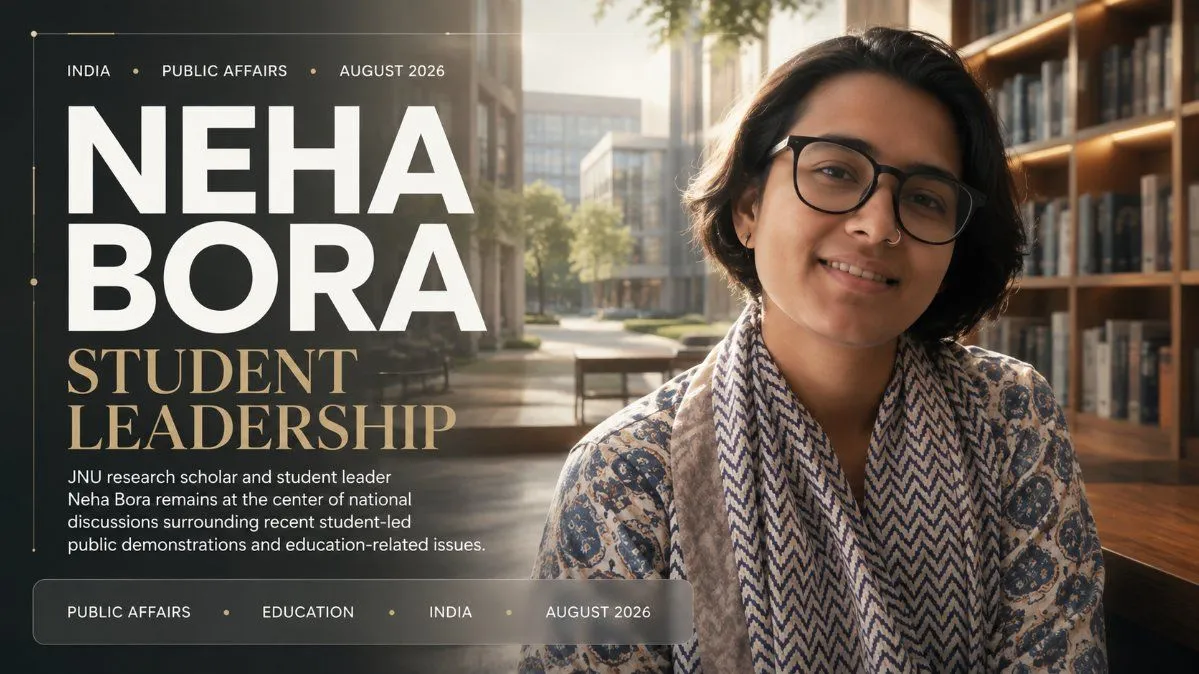
Neha Bora has emerged as one of India's most recognized student leaders through her involvement in higher education campaigns, student rights movements, and debates surrounding public education policy. A doctoral researcher at Jawaharlal Nehru University (JNU) and the national president of the All India Students' Association (AISA), Bora has become a prominent voice on issues ranging from examination reforms and paper leaks to access to affordable education and campus democracy.
Her public profile grew significantly during nationwide student protests connected to alleged examination irregularities and later through her participation in a prolonged hunger strike demanding accountability in education. Alongside her organizational responsibilities, she has continued her doctoral research while remaining active in discussions on education policy, student welfare, and democratic participation on university campuses.
Neha Bora received widespread national attention in 2026 after taking part in a prolonged hunger strike organized by student groups demanding greater accountability over examination-related controversies and reforms in India's education system.
The protest, held at New Delhi's Jantar Mantar, focused on issues including alleged paper leaks, transparency in recruitment examinations, and broader concerns about opportunities available to young job seekers. Bora became one of the leading public faces of the campaign as she continued the hunger strike for more than three weeks despite deteriorating health.
Medical concerns surrounding her condition attracted significant public attention. According to multiple published interviews and reports, doctors repeatedly warned about the physical impact of the fast, while student organizations continued pressing for dialogue with the government.
The movement gained additional visibility after political leaders, academics, activists, artists, and public personalities visited the protest site to express solidarity or discuss the demands raised by demonstrators. Bora also addressed several press interactions during the campaign, emphasizing that the movement represented concerns shared by students from different states and educational backgrounds.
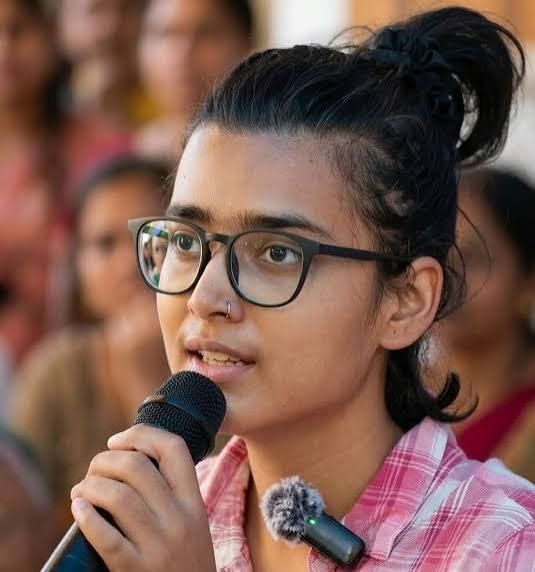
One of the most widely discussed moments came after police action during demonstrations in July 2026. Bora, despite her weakened physical condition, addressed supporters publicly. Videos of her speech circulated widely on social media, bringing additional national attention to the protest and to the broader debate surrounding education policy.
Following the conclusion of the hunger strike, Bora stated that ending the fast did not signify the end of the movement. Instead, she described it as one stage in a continuing campaign for educational reforms and student rights.
Although Neha Bora is primarily known as a student activist rather than a conventional political leader, her public work spans several interconnected areas.
As National President of AISA, she has represented the organization at student meetings, public discussions, demonstrations, university events, media interviews, and policy debates. Her responsibilities include coordinating campaigns, addressing student concerns, speaking at public events, and representing the organization in national discussions related to education.
Her recent public engagements have largely centered on:
Examination transparency
Recruitment reforms
Student welfare
Public education funding
Campus democracy
Equal access to higher education
Youth employment concerns
Bora has also appeared in numerous interviews discussing how prolonged uncertainty over examinations affects students emotionally, financially, and academically. Rather than limiting the conversation to individual examinations, she has argued for broader institutional reforms aimed at strengthening trust in public education systems.
Another significant aspect of her work is communication. Observers frequently note her ability to explain complex policy questions in accessible language during speeches, interviews, and public meetings. Her speeches often combine personal experiences from student movements with wider discussions about constitutional values, educational equality, and democratic participation.
Apart from organizational work, Bora continues pursuing doctoral research at Jawaharlal Nehru University. Balancing academic responsibilities with organizational leadership has become a recurring theme in media profiles about her.
Her public appearances also include panel discussions, student conventions, campus lectures, interviews with national publications, and conversations about higher education reforms.
Unlike many public figures, Bora's recent visibility has been driven almost entirely by educational activism rather than electoral politics.
Publicly available information about Neha Bora's childhood remains relatively limited. She has stated in interviews that she comes from Uttarakhand, while spending part of her early years in Siliguri, West Bengal.
Growing up in different regions exposed her to diverse educational and cultural environments. Those experiences later influenced her interest in questions of identity, public education, and social participation.
During her school years she reportedly developed interests extending beyond academics, including theatre, literature, and cultural activities. These creative pursuits later became closely connected with both her academic specialization and her approach to student activism.
Rather than entering public life immediately, Bora gradually became involved in campus discussions during her university education.
Education has remained central to both Neha Bora's academic and public journey.
She completed her undergraduate studies at the University of Delhi, where she became increasingly interested in student issues and campus organizations.
She later earned a master's degree from Dr. B.R. Ambedkar University Delhi.
Following postgraduate studies, she joined Jawaharlal Nehru University as a doctoral scholar in the School of Arts and Aesthetics.
Her doctoral work combines academic research with broader interests in culture, politics, public discourse, and artistic expression.
Throughout interviews, Bora has often emphasized that universities should encourage critical thinking, debate, and equal educational opportunities rather than functioning solely as degree-granting institutions.
Neha Bora's involvement in organized student activism developed gradually through participation in university discussions and campaigns.
Rather than seeking public recognition from the outset, she initially worked with student groups addressing issues such as fee increases, hostel facilities, scholarships, and educational accessibility.
Her organizational responsibilities expanded over time as she became associated with the All India Students' Association (AISA), one of India's prominent student organizations.
Before becoming national president, she served in important organizational roles, including leadership responsibilities within the Delhi unit.
These experiences helped build her profile inside student politics long before national media began covering her activities extensively.
Bora's transition from campus organizer to nationally recognized student leader occurred through sustained involvement in multiple educational campaigns.
She frequently represented AISA during demonstrations, university discussions, and public meetings concerning education policy.
Her visibility increased as she spoke on issues including:
Public education funding
Examination reforms
Student representation
Employment opportunities
Privatization debates
Campus inclusion
Media attention expanded considerably during nationwide protests connected with examination irregularities, where Bora emerged as one of the movement's most recognizable spokespersons.
Her willingness to participate directly in demonstrations—including the prolonged hunger strike—further strengthened her public profile.
Many supporters describe her leadership style as participatory, emphasizing collective decision-making and organizational coordination rather than personality-driven politics.
Several campaigns have defined Bora's public career.
Among the most significant are movements advocating greater transparency in competitive examinations and recruitment processes.
She has consistently argued that examination credibility directly affects millions of students preparing for careers in government services and higher education.
She has also spoken on:
Affordable education
Public universities
Campus safety
Student representation
Academic freedom
Democratic participation
In addition to education-focused campaigns, Bora has participated in broader public discussions concerning constitutional rights, social justice, and equal access to opportunities.
Unlike many public activists, Bora continues maintaining an active academic identity.
Her doctoral research at JNU's School of Arts and Aesthetics reflects continuing engagement with cultural studies, artistic practice, and critical inquiry.
Interviews suggest that she views scholarship and activism as complementary rather than separate pursuits, believing academic research should remain connected to contemporary social realities.
One characteristic frequently mentioned across interviews is Bora's public speaking ability.
Her speeches typically combine personal experiences, policy discussions, historical references, and constitutional principles.
During the 2026 student movement, several speeches gained substantial attention online, introducing her to audiences beyond university campuses.
Supporters praised her communication skills for presenting complicated educational issues in accessible language, while critics challenged her political positions. Regardless of differing viewpoints, her speeches contributed significantly to her growing national recognition.
Although Neha Bora has not built a career around awards or entertainment achievements, her influence has grown through sustained public engagement.
National newspapers, magazines, digital publications, and television discussions have increasingly featured her perspectives on student movements and education policy.
Her interviews often focus less on personal achievements and more on collective student concerns, reflecting her organizational role within AISA.
The attention generated by the 2026 hunger strike established Bora as one of the most widely recognized student leaders in contemporary Indian higher education.
| |
|---|
| |
| |
| Student leader, Research Scholar |
| National President, All India Students' Association (AISA) |
| University of Delhi; Dr. B.R. Ambedkar University Delhi |
Current Academic Institution | Jawaharlal Nehru University (JNU) |
| Ph.D. Scholar, School of Arts and Aesthetics |
| Student activism, education reform campaigns, AISA leadership |
| Uttarakhand, India (publicly reported) |
| |
| |
Throughout her public life, Neha Bora has consistently argued that higher education should remain accessible, affordable, and accountable. Her speeches and interviews frequently focus on the everyday challenges faced by students, including rising educational costs, uncertainty surrounding recruitment examinations, delays in hiring processes, and unequal access to quality education.
Rather than limiting her activism to one university or one state, Bora has often framed these concerns as national issues affecting millions of young people preparing for higher education and competitive examinations. She has emphasized that examination integrity is closely linked to students' confidence in public institutions and future employment opportunities.
Another recurring theme in her public statements is the importance of strengthening public universities. She has argued that universities should encourage academic freedom, critical thinking, research, and democratic participation while remaining accessible to students from different social and economic backgrounds.
One of the defining moments of Neha Bora's public career came during the nationwide protests over alleged examination paper leaks and recruitment irregularities.
As national president of AISA, Bora helped coordinate demonstrations, public meetings, and campaigns demanding greater transparency in the examination system. Student organizations participating in the movement argued that repeated allegations of paper leaks had created uncertainty for candidates who spent years preparing for competitive examinations.
The protests attracted participants from universities, coaching centres, and youth organizations across several states. During media interactions, Bora repeatedly stated that the movement represented not only university students but also aspirants preparing for government jobs whose careers had been affected by examination controversies.
The campaign eventually developed into one of the most visible student-led education movements in recent years. Bora became one of its principal spokespersons, addressing press conferences, public gatherings, and interviews with national publications.
Neha Bora's national visibility increased substantially after she participated in a 23-day hunger strike demanding action on examination-related concerns and broader educational reforms.
The fast, held at Jantar Mantar in New Delhi, drew support from students, activists, academics, and several public figures. Reports from the protest indicated that Bora's health deteriorated significantly during the fast, leading doctors to monitor her condition closely.
Despite the physical challenges, she continued addressing supporters whenever possible and reiterated that the protest sought institutional reforms rather than temporary political attention.
Following the conclusion of the hunger strike, Bora stated that the campaign would continue through democratic and constitutional means. She described the end of the fast as the conclusion of one phase rather than the end of the broader movement.
The hunger strike also brought renewed national attention to discussions surrounding competitive examinations, recruitment processes, and educational governance.
In several interviews, Bora has reflected on the role of student organizations within Indian democracy.
She has argued that student politics is not limited to campus elections but also involves participation in discussions on education, employment, constitutional values, and public policy. According to Bora, universities have historically served as spaces where young people engage with social issues while developing leadership skills and democratic values.
She has also spoken about the need for peaceful dialogue between educational institutions, governments, and student representatives, arguing that disagreements should be addressed through discussion rather than confrontation.
Although her political positions have generated differing opinions, Bora has maintained that student organizations should continue advocating for issues directly affecting students' academic and professional futures.
Leading a national student organization has also brought considerable public scrutiny.
As AISA president, Bora has frequently represented her organization in television debates, interviews, and public discussions where competing political viewpoints are presented. These appearances have contributed to her growing national profile while also exposing her positions to criticism from ideological opponents.
During interviews conducted after the 2026 protests, Bora acknowledged that sustained activism requires balancing organizational responsibilities with academic commitments. She also discussed the physical and emotional challenges associated with prolonged demonstrations and hunger strikes.
Her experiences during the protests highlighted the personal sacrifices that student leaders sometimes make while advocating for collective demands.
Despite her demanding public responsibilities, Bora has continued pursuing doctoral research at Jawaharlal Nehru University.
The School of Arts and Aesthetics, where she is enrolled as a Ph.D. scholar, is known for interdisciplinary research in visual culture, cinema, theatre, literature, performance studies, and related fields. Her academic background has influenced both her public speaking style and her broader understanding of cultural and political discourse.
Friends and colleagues interviewed in various publications have described her as someone who combines academic inquiry with organizational work, often participating in seminars, discussions, and cultural events alongside political activities.
This dual identity—as a researcher and activist—has become one of the defining features of her public profile.
Neha Bora's visibility has grown considerably through interviews published in newspapers, magazines, and digital media platforms.
Unlike celebrities or electoral politicians, her media presence has largely been shaped by issue-based reporting. Coverage has focused on education policy, student protests, university life, democratic participation, and youth employment rather than personal publicity.
In interviews, Bora generally avoids discussing her private life in detail. Instead, she emphasizes collective student concerns and the organizational goals of AISA. As a result, relatively little verified public information is available regarding her family or personal relationships.
Her communication style is frequently described as measured and research-oriented, with an emphasis on explaining the reasoning behind policy demands rather than relying solely on slogans.
Neha Bora has kept most aspects of her personal life out of the public domain.
While publicly available profiles confirm her academic background and organizational responsibilities, she has not shared detailed information regarding her family, marital status, or other private matters. Consequently, such information has not been widely documented by reliable public sources.
Her interviews instead concentrate on education, student welfare, public policy, and organizational work, reflecting her preference for keeping the focus on the issues she represents.
Although Neha Bora is still in the early stages of her public career, she has already become one of the most recognizable student leaders associated with contemporary debates on higher education in India.
Her leadership during nationwide education-related protests, participation in a prolonged hunger strike, and consistent advocacy for examination transparency have contributed to her prominence within student politics.
Supporters view her as a determined advocate for educational accountability and student participation in policymaking, while critics disagree with aspects of her political ideology. Regardless of these differing perspectives, her role in recent student movements has ensured that she remains an influential figure in discussions about higher education and youth activism.
As she continues both her doctoral research and organizational responsibilities, Bora is likely to remain an important voice in conversations surrounding universities, public education, and student rights.